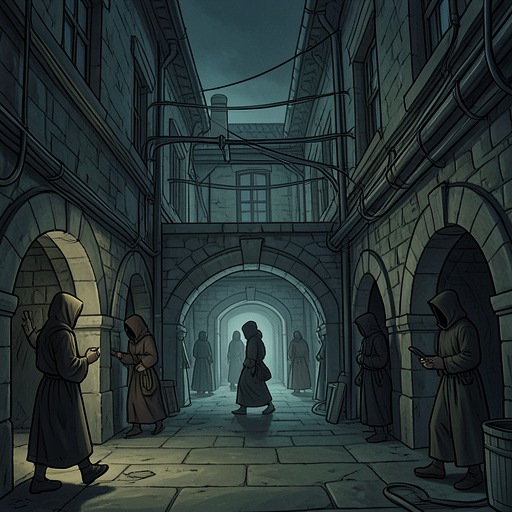
The Jackal–Valmy clandestine contact
The Day of the JackalThe Jackal–Valmy clandestine contact is a two-way telephone link that gives the Jackal advance warning of the police search and, once compromised, becomes one of the means by which Claude Lebel tracks him. Its importance lies in the changing balance of information: Valmy first lets the fugitive stay ahead of the investigation, but the discovery of the calls allows Lebel to identify the leak and briefly impersonate the informant himself.
A hidden channel within the manhunt
Valmy’s calls reach the Jackal as the French authorities build a large-scale search from records, reports, and coordinated inquiries. The scale of that system makes the contact especially consequential. The RG’s Pantheon archives hold four and a half million personal dossiers along five and a half miles of shelves, including information about people merely suspected of crimes, as well as witnesses and acquitted defendants. Separate collections include fingerprints and ten and a half million cards, among them border disembarkation records and hotel registration cards. The DST screens disembarkation cards at entry points, while Paris hotel cards go to the Prefecture de Police. This is a state apparatus designed to make movement legible; Valmy’s warnings help the Jackal exploit the intervals before its records and investigations converge.
The contact has a routine. On the morning of August 21, at the Château de la Haute Chalonnière, the Jackal stands in the Baron’s study and makes his usual call to Paris. He opens with “Ici Chacal”; the husky voice answers, “Ici Valmy.” Valmy reports that the authorities have found the car. The news changes the Jackal’s immediate plans: though he wants to remain at the château for two more days, he decides he must leave as soon as possible. The call also contains a small warning sign. The Jackal recalls a soft click shortly after connecting, something absent from his calls during the previous three days. He suspects that someone may have been listening on an extension in the bedroom, where Colette had been asleep—or seemed to be.
The leak is exposed
The click acquires significance when the investigators capture another exchange. At six in the morning, Lebel and Lucien Caron listen to a recording made by DST engineers. After the sound of a call being dialled and answered, a woman identifies herself as Jacqueline Dumas and warns Valmy that the police know their quarry is posing as a Danish parson. She says the authorities are sorting Paris hotel registration cards for Danes through the night, with collections at midnight, two, and four o’clock, and will then visit each person. Valmy replies, “Merci.” The warning gives the Jackal precisely the kind of operational detail that could help him evade the next round of checks.
The recording changes the meaning of the contact. What had appeared to be a private line between an informant and a fugitive is now a traceable connection, and the disclosure itself identifies the investigation’s method. By working out the number from the delay as the dial returned to zero, the investigators obtain an address. Lebel tells Caron, “Come on, Lucien. Let's go and pay a call on Monsieur Valmy.” When Caron asks about the woman, Lebel answers, “Oh, she'll have to be charged.” The intercepted call therefore does more than reveal that intelligence is leaking: it gives the police a route to the people carrying it.
Lebel turns the channel against the fugitive
After Valmy’s arrest, Lebel makes a calculated attempt to take over the contact rather than simply close it. When the Jackal calls and identifies himself with “Ici Chacal,” Lebel answers, “Ici Valmy.” Asked what is new, he says, “Nothing. They've lost the trail in Correze.” The reassurance is false. Lebel’s purpose is to keep the Jackal where he is for a few more hours, but the Jackal does not trust the message. He reasons that the police must have traced the taxi-driver in Egletons, found the body at the château, located the missing Renault in Tulle, and questioned railway staff. The call ends quickly, and the Jackal leaves his hotel in Paris.
Lebel later explains that the leak had repeatedly given the Jackal a head start. The fugitive had left Gap in haste and killed the woman at La Chalonnière before the police net closed; on another occasion, Valmy’s information had also preceded an attempted move against him. Lebel says the arrest of Valmy, together with his own inability to impersonate Valmy convincingly, prompted the Jackal to abandon his current position and adopt another identity. To substantiate the accusation that the escapes were not simply luck, Lebel plays the recorded telephone conversation in the conference room. Colonel Saint-Clair turns ashen and trembles while gathering his papers, a reaction that underscores the political and institutional reach of the leak.
Function and consequence
The contact operates as an information channel rather than a partnership shown in personal or emotional terms. Its intimacy is procedural: a familiar opening phrase, a recurring call, terse exchanges, and warnings about police actions. That economy suits the fugitive’s need for usable intelligence, while making small irregularities—such as the click on the line—potentially decisive. The exchange does not make the Jackal invulnerable; it buys time, and time can be lost as soon as the channel is monitored or its source compromised.
The relationship also sharpens the contrast between two kinds of surveillance. The authorities gather names, fingerprints, border entries, and hotel cards, and they monitor telephone traffic; Valmy counters by disclosing what those systems are doing. Once the recording turns the line into evidence, however, the police can identify the people transmitting warnings and feed the Jackal information through the very channel he trusts. The contact’s decisive consequence is therefore its reversal: Valmy’s access helps the Jackal evade the manhunt, but the exposed communication lets Lebel pursue him through his own expectations of what Valmy would say.